Walk into any small office in Hyderabad at 7 PM — a trading firm in Begumpet, a clinic back-office in Secunderabad, a D2C warehouse in Kukatpally — and you’ll find someone doing the same thing they did yesterday: copying numbers into Excel, chasing leads one by one on WhatsApp, or building the same report again. These are exactly the business tasks you should automate with Python, and most of them cost less to automate than one month of the staff time they eat.
Below are the 10 automations we build most often for Indian businesses in 2026, with honest numbers for each: hours saved, what it costs to build, and how fast it pays for itself. The quick math we’ll use throughout: back-office staff time in Hyderabad costs roughly ₹100–₹200 per hour once you count salary, so every 10 hours saved a month is ₹1,000–₹2,000 back in your pocket — every month, forever.
The 10 Tasks, Ranked by How Often They Pay Off
The best tasks to automate share three traits: they repeat on a schedule, they follow the same rules every time, and a mistake in them is annoying but not deadly. Everything on this list fits that pattern.
1. Report and invoice generation
Saves 4–10 hours/week · Build cost ₹3,000–₹15,000 · Pays back in 1–2 months
If someone builds the same Excel or PDF report every Monday — sales summary, GST-ready invoice batch, client statements — a Python script (using pandas and ReportLab) can produce it in seconds from your raw data. This is the single most common first automation, and the one with the fastest payback. A Begumpet distributor we know cut a 6-hour Monday ritual to a 4-minute scheduled job.
2. Competitor price monitoring
Saves 3–8 hours/week · Build cost ₹8,000–₹40,000 · Pays back in 2–5 months
Sellers on Amazon.in, Flipkart, and Meesho check rival prices by hand — or worse, don’t check at all. A scraper checks hundreds of listings every morning and flags where you’ve been undercut. The catch: cost depends heavily on how protected the target sites are, so get a quote after showing the developer the actual links.
3. Lead capture and WhatsApp follow-up
Saves 5–12 hours/week · Build cost ₹10,000–₹40,000 · Pays back in 1–3 months
A lead fills your Facebook form or portal enquiry, and within two minutes they get a WhatsApp message while the lead lands in your CRM and your sales person gets pinged. For Kondapur real estate teams this is the highest-value automation on the list — in that market, the first agent to respond usually wins, and a 2-minute reply beats a 2-hour one every single time.
4. Data entry between systems
Saves 6–15 hours/week · Build cost ₹8,000–₹35,000 · Pays back in 1–3 months
The classic Indian SMB pain: orders in one portal, accounts in Tally, stock in Excel, and a person retyping between all three. Python moves the data instead — via APIs where they exist, file exports where they don’t. Bonus that surprises owners: the retyping errors disappear too, which often matters more than the hours.
5. Email inbox processing
Saves 2–6 hours/week · Build cost ₹5,000–₹25,000 · Pays back in 2–4 months
Scripts that read a shared inbox, pull out attachments (supplier invoices, bank statements, POs), rename and file them properly, and log each one in a sheet. Add AI reading (more on task 9) and it can extract the amounts and due dates too. Quietly one of the most loved automations we deliver — nobody misses inbox filing.
6. Appointment and payment reminders
Saves 3–8 hours/week · Build cost ₹8,000–₹30,000 · Pays back in 1–3 months
Clinics, salons, tuition centres, and anyone who invoices on credit: automatic WhatsApp/SMS reminders the day before an appointment or when a payment crosses its due date. Clinics around Banjara Hills and Secunderabad see no-show rates drop noticeably once reminders go out reliably — machines don’t forget, staff on a busy Saturday do.
7. Review and reputation monitoring
Saves 1–4 hours/week · Build cost ₹5,000–₹20,000 · Pays back in 3–6 months
A script that watches your Google Business Profile (and Practo, Zomato, JustDial — whatever your industry lives on), alerts you the moment a review lands, and drafts a suggested reply for you to approve. Fast responses to bad reviews are a rankings and trust factor — but the drafts should always get a human look before posting.
8. Inventory sync across marketplaces
Saves 4–10 hours/week · Build cost ₹15,000–₹50,000 · Pays back in 2–5 months
Selling the same stock on Amazon, Flipkart, and your own Shopify store means overselling the moment one channel doesn’t know what the other sold. An automation syncs stock counts across channels every few minutes. For Kukatpally and Ameerpet warehouse sellers, this one prevents the most expensive mistake in e-commerce: cancelling a paid order.
9. Document data extraction (AI + OCR)
Saves 5–15 hours/week · Build cost ₹25,000–₹1,00,000 · Pays back in 3–8 months
The 2026 upgrade to old-school automation: AI reads scanned invoices, KYC documents, delivery challans, or medical reports and turns them into structured rows in your system. Costlier to build than the rest of this list, but for document-heavy businesses — CA firms, diagnostics labs, logistics — it replaces entire data-entry roles’ worth of hours.
10. Website, rank, and uptime monitoring
Saves 1–3 hours/week · Build cost ₹5,000–₹20,000 · Pays back in 3–6 months
A script that checks your site is up, your booking form actually works, and where you rank on Google for your main keywords — then sends you a weekly summary instead of you spot-checking by hand. The uptime alerts alone earn their keep the first time your payment page silently breaks on a Sunday.
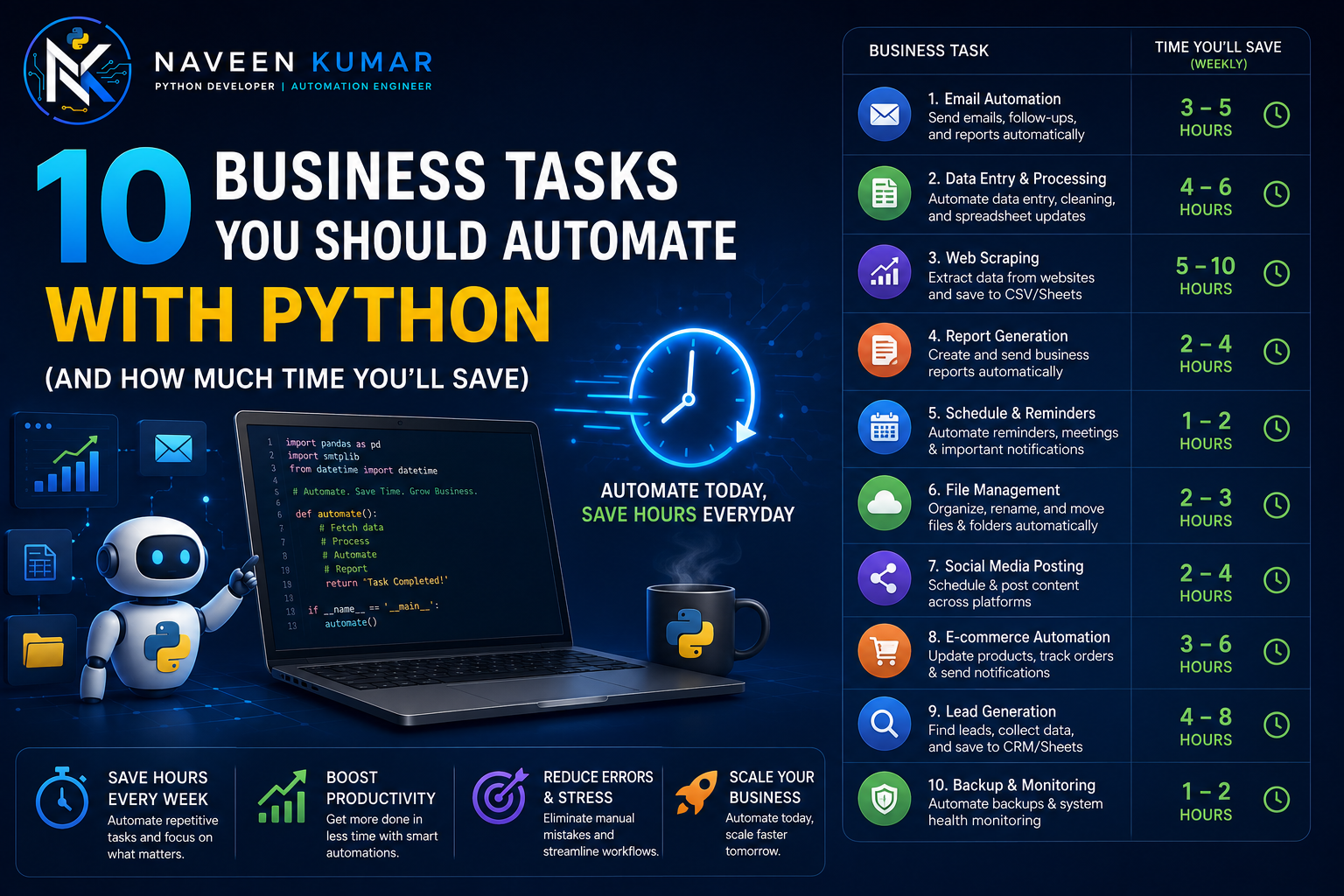
All 10 at a Glance
Total picture: a business that automates 3–4 tasks from this list typically frees up 15–30 staff hours a month for a one-time spend of ₹30,000–₹80,000 — with most individual automations paying for themselves inside 3 months.
| # | Task | Time Saved | Build Cost (₹) | Payback |
|---|---|---|---|---|
| 1 | Report & invoice generation | 4–10 hrs/wk | 3,000–15,000 | 1–2 months |
| 2 | Competitor price monitoring | 3–8 hrs/wk | 8,000–40,000 | 2–5 months |
| 3 | Lead capture & WhatsApp follow-up | 5–12 hrs/wk | 10,000–40,000 | 1–3 months |
| 4 | Data entry between systems | 6–15 hrs/wk | 8,000–35,000 | 1–3 months |
| 5 | Email inbox processing | 2–6 hrs/wk | 5,000–25,000 | 2–4 months |
| 6 | Appointment & payment reminders | 3–8 hrs/wk | 8,000–30,000 | 1–3 months |
| 7 | Review monitoring | 1–4 hrs/wk | 5,000–20,000 | 3–6 months |
| 8 | Inventory sync | 4–10 hrs/wk | 15,000–50,000 | 2–5 months |
| 9 | Document extraction (AI) | 5–15 hrs/wk | 25,000–1,00,000 | 3–8 months |
| 10 | Website & rank monitoring | 1–3 hrs/wk | 5,000–20,000 | 3–6 months |
These are 2026 Indian freelance-market rates; agencies typically quote 2x or more for the same builds. Scheduled automations also need a small cloud server, ₹400–₹1,500/month, shared across all your automations.
How to Pick Your First Automation (Without Wasting Money)
Start with the most boring, most frequent, most rule-based task you have — not the most complex one. A small first win builds trust in the approach; a big ambitious first project is how automation budgets die.
A simple exercise that takes 15 minutes: for one week, have your team note every task they do more than once. Then score each task on three questions — how often does it happen, does it follow the same steps every time, and what happens if it goes wrong once. High frequency + fixed rules + low blast-radius = automate it first. Tasks needing judgement calls on every item stay human (or become AI-assisted with human approval, like task 7).
Two warnings from projects we’ve cleaned up after:
- Don’t automate a broken process. If your lead follow-up is chaos on paper, automating it gives you faster chaos. Fix the steps first, then automate the fixed version.
- Insist on handover. Source code, a plain-language how-to document, and admin access. An automation only you can’t touch isn’t an asset, it’s a dependency.
Python Automation for Businesses in Hyderabad, Telangana
Hyderabad businesses get automation cheaper than almost anywhere — the HITEC City–Gachibowli–Madhapur talent belt keeps freelance rates 10–20% below Mumbai and New Delhi, level with Bangalore, Chennai, and Pune — while local staff costs make the payback math work even for small shops.
What we see across the city in 2026, by area and industry:
- Trading and distribution firms around Begumpet and Secunderabad lean on tasks 1 and 4 — reports and Tally-to-Excel bridges are the bread and butter.
- Real estate teams in Kondapur, Kokapet, and Tellapur live and die by task 3 — lead speed in the western corridor market.
- Clinics and labs in Banjara Hills and Himayatnagar run tasks 6 and 9 — reminders plus AI report extraction.
- Marketplace sellers out of Kukatpally and Ameerpet stack tasks 2 and 8 together — price intelligence plus stock sync.
One seasonal note that catches people out: if your automation runs on an office desktop, monsoon season (June–September) power cuts and network drops will break it exactly when you stop watching. Put scheduled automations on a cloud server from day one — it’s the cheapest reliability money buys.
Naveen Kumar Software Solutions builds every automation on this list — Python scripts, scrapers, WhatsApp integrations, and AI document processing — from Hyderabad, with remote delivery across Mumbai, Bangalore, New Delhi, Chennai, Noida, and Pune. Standard delivery is 3–10 working days per automation, source code and documentation included, with an optional ₹3,000–₹10,000/month maintenance retainer if you’d rather never think about it again.
Frequently Asked Questions
What business tasks can Python automate?
Python can automate almost any repetitive computer task: report and invoice generation, competitor price tracking, lead follow-ups on WhatsApp, data entry between systems, email sorting, appointment reminders, review monitoring, inventory syncing, document data extraction, and website monitoring. If a task follows the same steps every time, it’s a candidate.
How much time can automation actually save a small business?
A typical small business automating 2–3 of its most repetitive tasks saves 15–30 staff hours per month. At Indian back-office staff costs of roughly ₹100–₹200 per hour, that’s ₹1,500–₹6,000 of labour per month per task — which is why most automations pay for themselves within 3–8 months.
Which task should I automate first?
Start with the task that is most frequent, most boring, and most rule-based — usually report generation or lead follow-up. Avoid starting with your most complex process. A small first win (₹5,000–₹15,000, one week) proves the approach before you spend bigger.
Do I need to know Python myself to use these automations?
No. A developer builds the automation and hands it over with simple controls — usually it just runs on a schedule, or your staff trigger it with one click. You should still ask for the source code and a short how-to document, so you’re never locked in to one developer.
What does a typical Python automation cost in India?
Simple scripts cost ₹3,000–₹12,000, scrapers and multi-step automations ₹8,000–₹40,000, and AI-powered document or chat automations ₹25,000–₹1,00,000. Scheduled automations add a small server cost of ₹400–₹1,500 per month. Most projects deliver in 3–10 working days.
Which of These 10 Is Eating Your Week?
Tell us the task — even a voice note describing it works. We’ll reply within one working day with whether it’s automatable, a fixed quote, and the payback math for your case, so you can decide with real numbers. No charge for the assessment.