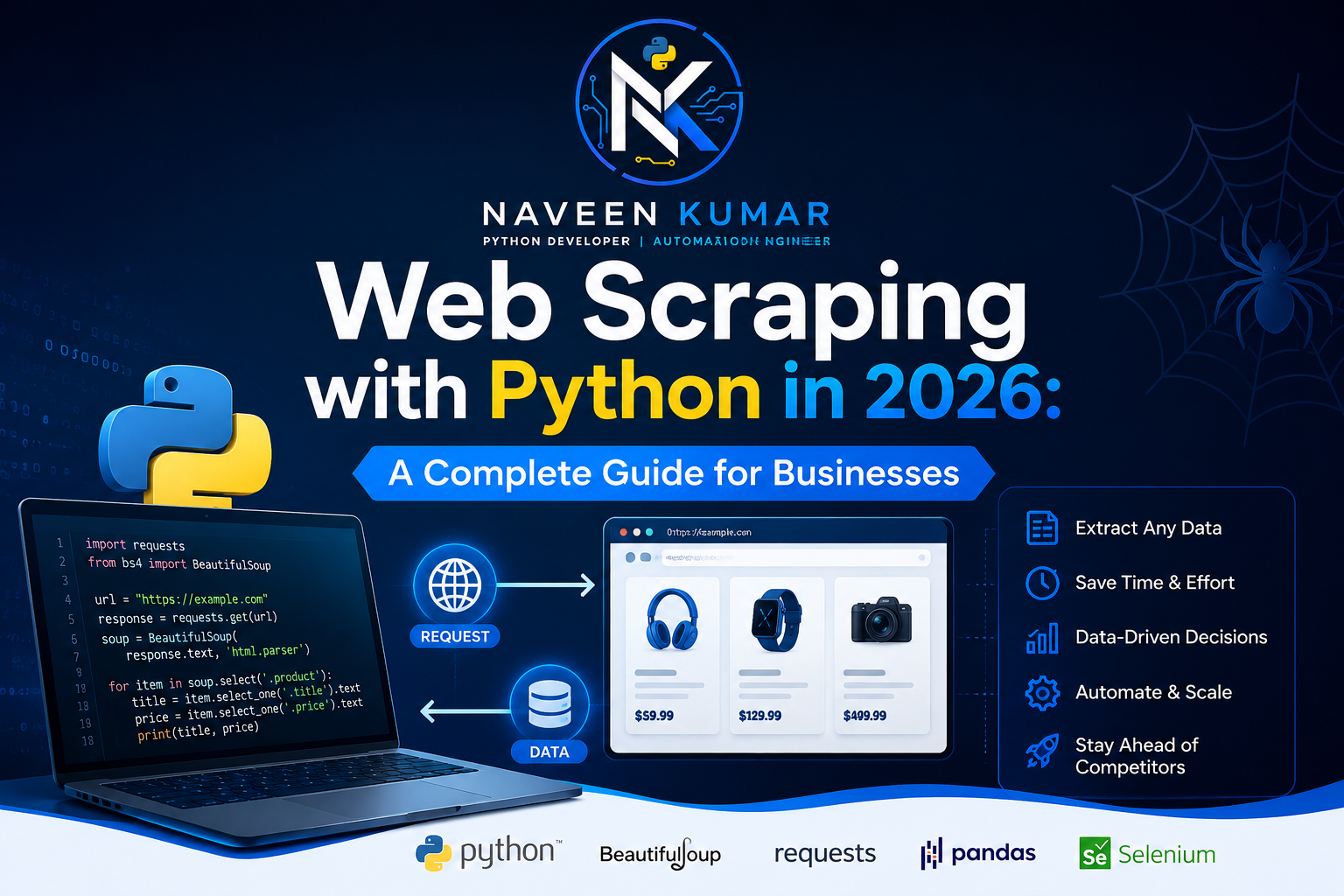
If you run a business in Hyderabad — maybe an e-commerce store in Madhapur, a real estate agency near Gachibowli, or a pharma distributor out in Genome Valley — you’ve probably wished you could pull competitor prices, property listings, or supplier data straight off the web into a spreadsheet. That’s exactly what web scraping with Python does. It’s software that visits websites the way a person would, reads the information on the page, and saves it in a clean, usable format like Excel or a database.
In 2026, Python is still the number one language for this work. It’s readable, it has mature scraping libraries, and there’s a huge pool of developers in India who know it well. This guide explains what web scraping is, what it costs, whether it’s legal in India, and how to get a scraper built for your business without wasting money.
What Is Web Scraping, in Plain Terms?
Web scraping is automated data collection from websites. Instead of an employee copying prices or listings by hand for hours, a Python script does the same job in minutes — and it can repeat the job every day, on a schedule, without mistakes from tired eyes.
Here’s a simple example. Say you sell mobile accessories online from a warehouse in Kukatpally. Your competitors change prices two or three times a week. A scraper can check 500 competitor product pages every morning at 6 AM, drop the results into a Google Sheet, and flag any item where you’ve been undercut. What used to take a staff member half a day now takes a script four minutes.
The “with Python” part matters because Python has purpose-built tools for this:
- Requests + BeautifulSoup — for simple, static websites. Fast and cheap to build.
- Scrapy — a full framework for scraping thousands of pages at scale, with built-in retry logic and data pipelines.
- Playwright and SeleniumBase — browser automation tools for modern JavaScript-heavy sites (think React or Next.js frontends) where the data only appears after the page loads in a real browser.
A good developer picks the lightest tool that gets the job done. Using a full browser to scrape a simple static page is like hiring a lorry to deliver a dosa.
Is Web Scraping Legal in India in 2026?
Scraping publicly available data is generally legal in India, but there are real limits you should know before you commission a project.
There’s no single Indian law that bans web scraping. Courts in India and abroad have repeatedly treated public data — prices, listings, published business information — as fair game to collect. But three things change the picture:
- The DPDP Act (Digital Personal Data Protection Act). If a scraper collects personal data of individuals — names, phone numbers, email addresses — you fall under India’s data protection rules. Scraping product prices is one thing; scraping people’s contact details for cold outreach is a different legal category entirely.
- Terms of Service. Many sites prohibit automated access in their terms. Violating ToS is usually a civil matter, not a criminal one, but it can get your IP addresses blocked and, in rare commercial disputes, land you in court.
- Login-protected data. Scraping data behind a login, especially by sharing or automating accounts, is far riskier legally and technically. Most reputable developers (ours included) will tell you to avoid it or find the official API instead.
The short version: scraping public prices, listings, reviews, and business data for market research is standard practice across India. Scraping personal data or gated content is where you need legal advice, not just a developer.
What Do Businesses Actually Use Scraping For?
The most common paid scraping projects in 2026 fall into a handful of buckets — price monitoring, lead generation, real estate data, SEO tracking, and hiring intelligence — and most pay for themselves within a few months.
Price and competitor monitoring
E-commerce sellers track competitor prices daily and adjust their own automatically. This is the single most requested scraping project we see from Hyderabad sellers on Amazon.in, Flipkart, and Meesho.
Lead generation and market research
Collecting business listings — say, every dental clinic in Telangana with a Google Business Profile, along with ratings and review counts — to build a sales pipeline or study a market before entering it.
Real estate data
Agents and investors scrape portals for new listings, price-per-square-foot trends in areas like Kondapur or Miyapur, and days-on-market data. In a market that moves as fast as Hyderabad’s western corridor, being six hours ahead of a manual search is a real edge.
SEO and rank tracking
Checking where your website ranks on Google across dozens of keywords and locations. Local businesses use geo-grid rank scans to see how their Google Maps visibility changes from one neighborhood to the next — HITEC City versus Secunderabad can be two different worlds for the same keyword.
Job market and hiring intelligence
HR firms and staffing agencies scrape job boards to spot which companies are hiring, for what roles, and at what pace.
How Does a Scraping Project Actually Work, Step by Step?
A typical scraping project goes from first call to delivered data in one to three weeks, depending on the target sites.
- Scoping (1–2 days). You show the developer the websites and the exact data fields you want — product name, price, seller, stock status, whatever matters to you. The developer checks how the sites are built and whether they use anti-bot protection.
- Prototype (2–5 days). A first version scrapes a small sample — maybe 100 records — so you can confirm the data is correct before full development.
- Full build (3–10 days). The scraper is scaled up, error handling is added, and output goes to your preferred format: Excel, CSV, Google Sheets, or a database.
- Scheduling and delivery. The script runs on a schedule (daily, hourly, weekly) either on your machine, a cheap cloud server (₹400–₹1,500/month), or the developer’s infrastructure.
- Maintenance. Websites change their layout without warning. Expect a scraper to need small fixes two to four times a year. Any quote that doesn’t mention maintenance is hiding a future cost.
What Does Web Scraping Cost in 2026?
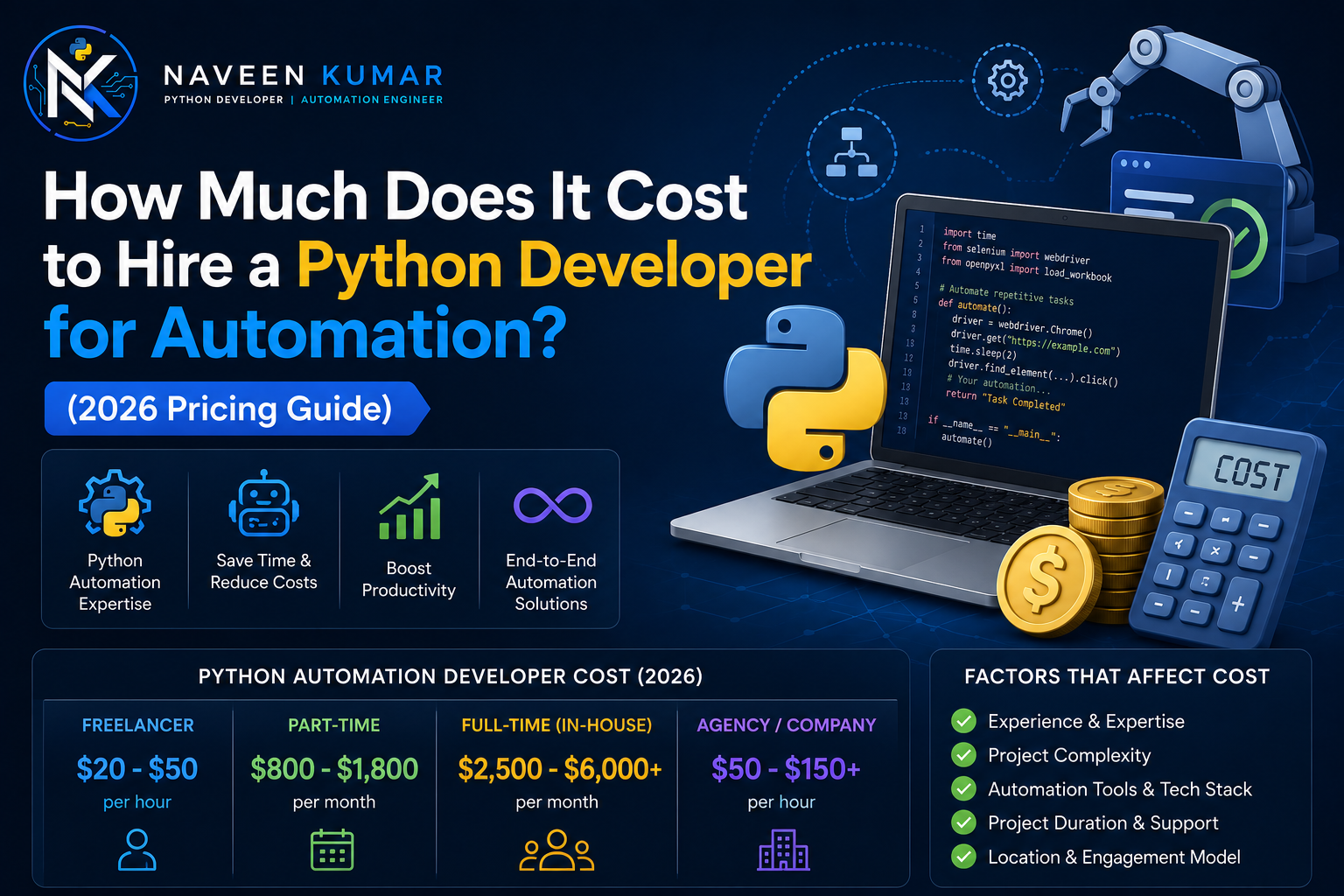
For a business in India, a custom Python scraper typically costs between ₹8,000 and ₹80,000 as a one-time build, with the price driven mostly by the target site’s difficulty — not the amount of data.
| Project Type | Typical Cost | Notes |
|---|---|---|
| Simple static site, one-time extraction | ₹8,000–₹20,000 | Directories, sites without heavy JavaScript |
| JavaScript-heavy site (browser automation) | ₹20,000–₹50,000 | Needs Playwright/SeleniumBase, more testing |
| Anti-bot protected sites | ₹40,000–₹80,000+ | Rotating proxies add ₹1,500–₹8,000/month |
| Ongoing scheduled scraping + reports | ₹5,000–₹25,000/month | Includes hosting, monitoring, layout fixes |
One honest warning: if a site has serious bot protection and explicitly forbids scraping, the right answer is sometimes “check if they sell an official data feed or API.” A good developer will tell you that upfront instead of billing you for a fragile workaround.
Build In-House or Hire a Developer?
If scraping is core to your product, hire in-house. If it’s a supporting tool — price checks, lead lists, rank reports — outsourcing to a specialist is almost always cheaper.
A junior Python developer’s salary in Hyderabad runs ₹4–8 lakh a year. That only makes sense if you have year-round scraping and data work to fill their time. For most SMBs, a project-based engagement with a freelancer or small firm gets the same output for a fraction of the cost — and an experienced scraper developer will finish in days what a generalist junior takes weeks to figure out, especially around anti-bot handling and data cleaning.
Questions worth asking anyone you’re about to hire:
- Can you show a sample of past scraped output (with client details removed)?
- How do you handle a site that changes its layout?
- What happens if the site blocks your IPs?
- Is the code delivered to me, or do you keep it? (You should get the code.)
- Do you refuse projects involving personal data or gated content? (The right answer is yes.)
Web Scraping for Businesses in Hyderabad, Telangana
Hyderabad is one of the best cities in India to get a scraper built, for a simple reason: supply. The HITEC City–Gachibowli–Madhapur belt has one of the country’s densest concentrations of Python talent, so rates here are competitive with Bengaluru and noticeably lower than what Mumbai or New Delhi agencies quote for the same work.
The local demand side is just as strong. Hyderabad’s biggest scraping use cases track its dominant industries:
- Pharma and life sciences around Genome Valley scrape tender portals, drug price lists (NPPA data), and global supplier catalogs.
- Real estate across the western corridor — Kondapur, Narsingi, Tellapur, Kokapet — where new project launches move fast and investors want listing data daily, not monthly.
- E-commerce and D2C brands operating out of Kukatpally, Ameerpet, and Begumpet warehouses monitoring marketplace prices and Buy Box changes.
- IT services and staffing firms in Madhapur scraping job boards and company career pages for sales intelligence.
One practical local note: monsoon season (roughly June to September) is when home-office power cuts and network drops break locally-run scrapers most often. If your script needs to run reliably every day, put it on a cloud server from day one rather than an office desktop — it’s a few hundred rupees a month and saves the “why is Tuesday’s data missing” headache.
Naveen Kumar Software Solutions builds custom Python scraping tools — from single-site price monitors to multi-city SEO rank tracking systems — for clients in Hyderabad and across India, with remote delivery to Mumbai, Bengaluru, and New Delhi as well. Typical turnaround for a standard project is 5–10 working days, with the source code handed over to you at the end.
Frequently Asked Questions
Is web scraping legal for my business in India?
Scraping publicly available, non-personal data (prices, listings, published business info) is generally legal in India. Collecting personal data triggers the DPDP Act, and scraping behind logins carries extra risk. When in doubt on a specific target site, get a quick legal opinion before commissioning the build.
How much does a Python web scraper cost?
Most custom scrapers for Indian SMBs cost ₹8,000–₹80,000 as a one-time build, depending on how hard the target site is to scrape — not how much data you want. Ongoing scheduled scraping usually runs ₹5,000–₹25,000 per month including hosting and fixes.
How long does it take to build a web scraper?
A simple scraper takes 2–5 days. A project involving JavaScript-heavy sites or anti-bot protection takes 1–3 weeks. You should see a working sample of real data within the first week of any project.
Do scrapers break? What happens then?
Yes — websites redesign their pages without notice, and the scraper needs a small code update when that happens. Expect two to four fixes a year per target site. Ask any developer upfront whether maintenance is included or billed separately.
Can scraping get my company blocked or banned?
A badly built scraper that hammers a site with rapid requests will get IP-blocked quickly. A well-built one paces its requests, respects the site’s load, and uses rotating proxies where appropriate. Blocks affect the scraper’s IPs, not your company’s regular internet access.
Ready to Turn Web Data Into a Business Advantage?
Send us the site and the data fields you want. We’ll tell you honestly whether it’s scrapeable, what it’ll cost, and how long it’ll take — usually within one working day.