You’re planning an app or a web tool — maybe a booking system for your clinic in Banjara Hills, a customer portal, or the backend for a mobile app — and the developer you spoke to in Madhapur asked a question you didn’t expect: “FastAPI, Flask, or Django?” Now you’re stuck comparing three names that all sound the same. Here’s the honest 2026 answer to the FastAPI vs Flask vs Django question in one paragraph.
FastAPI is the default choice for APIs, mobile app backends, and anything touching AI. Django is the fastest way to a full product — user logins, admin panel, database — out of the box. Flask fits small, simple tools where you want the least machinery possible. All three are Python, all three are free, and all three are actively maintained in 2026. The rest of this guide explains how to pick, what each costs to build and run, and the mistakes that get expensive later.
What Are FastAPI, Flask, and Django, in Plain Terms?
All three are Python web frameworks — the foundation your app’s server side is built on. Think of them as three ways to construct the same building: Django gives you a furnished flat, Flask gives you an empty plot with good roads, and FastAPI gives you a modern shell built for speed.
A backend (the server side) is the part of your app users never see: it stores data, checks logins, talks to payment gateways, and answers requests from your website or mobile app. The framework decides how much of that comes pre-built.
- Django (2005) — the “batteries included” one. Database handling (ORM), user accounts, security protections, and a ready-made admin panel come built in. Instagram and large parts of Indian fintech run on it.
- Flask (2010) — the minimal one. It gives you routing and almost nothing else; you add only what you need. Small, readable, and quick to start.
- FastAPI (2018) — the modern API specialist. Built on Python type hints, it validates incoming data automatically (via Pydantic), handles many requests at once (async), and generates interactive API documentation by itself. It’s become the default for new API and AI projects.
Side-by-Side: The Differences That Actually Matter
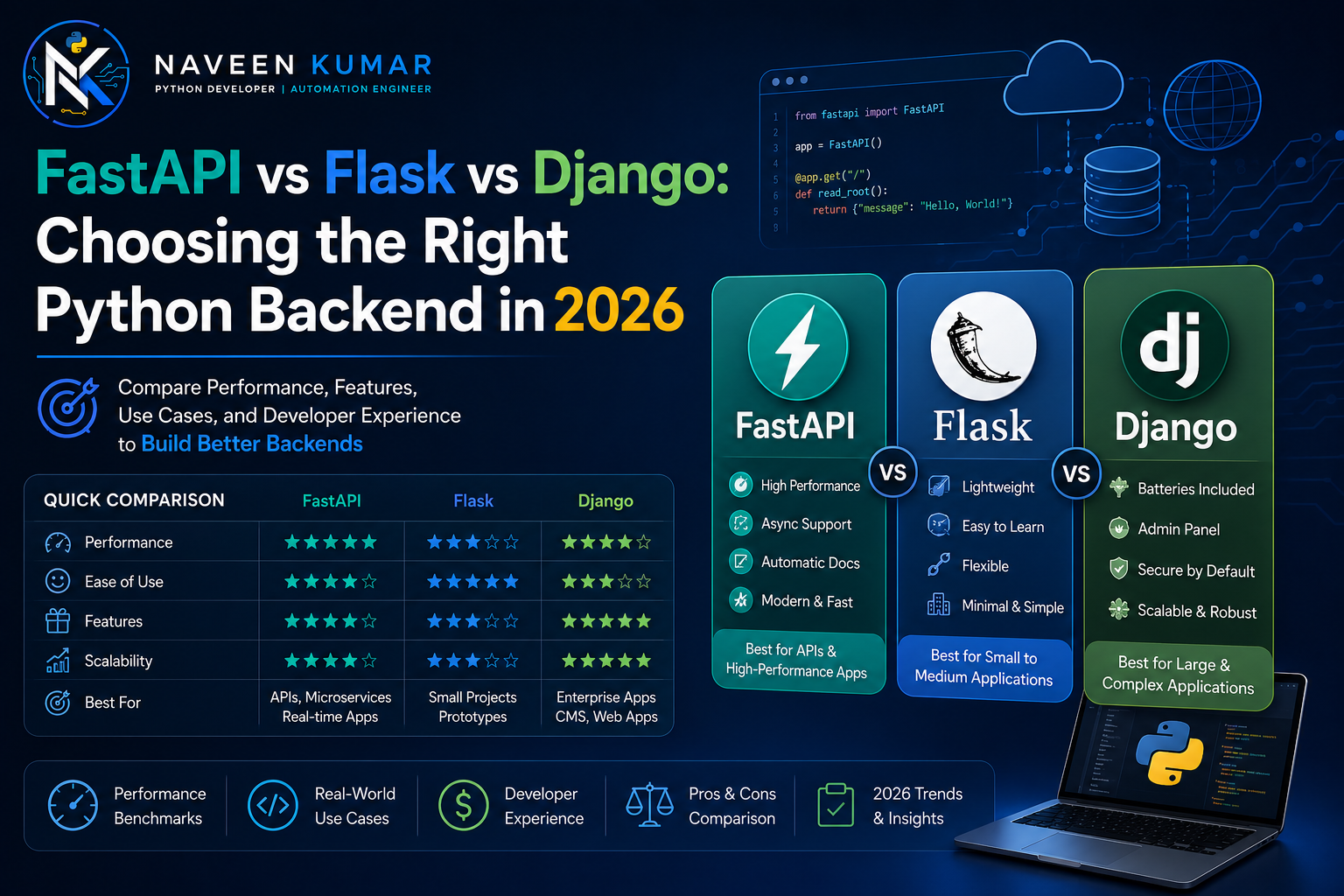
The real differences are in what comes built in, how they handle traffic, and what kind of project each finishes fastest — not in which one is “better” on a benchmark chart.
| FastAPI | Flask | Django | |
|---|---|---|---|
| Best for | APIs, mobile backends, AI services | Small tools, simple sites | Full products with users & admin |
| Built-in admin panel | No | No | Yes — a big time saver |
| Automatic API docs | Yes (Swagger built in) | No (add-ons needed) | Via Django REST Framework |
| Data validation | Automatic (Pydantic) | Manual / add-ons | Forms & serializers |
| Handles many requests at once (async) | Native, its core strength | Partial | Improving, still secondary |
| Learning curve | Low–medium | Lowest | Medium — most concepts to learn |
| Typical build cost (India, 2026) | ₹15,000–₹60,000 for an API backend | ₹8,000–₹40,000 for a small tool | ₹60,000–₹2,50,000 for a full product |
Hosting is roughly the same story for all three: a small project runs happily on a ₹400–₹2,000/month cloud server. The framework choice barely changes your server bill at small scale.
Does “FastAPI Is Faster” Actually Matter for Your Project?
For most business apps, raw framework speed is not your bottleneck — your database and your code are. FastAPI’s async advantage matters in specific cases: high traffic, many simultaneous users, or workloads that wait on other services (like AI model calls).
Here’s the plain truth behind the benchmark wars. FastAPI can handle far more simultaneous requests per server because it doesn’t sit idle while waiting for a database or an external API to respond. If you’re building a WhatsApp bot backend that calls an AI model — where each request waits 2–5 seconds for the model — that’s exactly where FastAPI shines and Flask struggles.
But if you’re building an internal dashboard that 15 staff members use, all three frameworks are so far from their limits that the difference is invisible. Don’t let a benchmark chart pick your framework; let the project type pick it.
When to Pick Each One: A Decision Guide
Pick by answering one question: what is the deliverable? An API or app backend → FastAPI. A full website product with logins and admin → Django. A small internal tool → Flask (or FastAPI anyway).
Choose FastAPI if…
- You’re building the backend for a mobile app (Android/iOS) or a React/Vue frontend.
- The project involves AI — chatbots, document processing, agents. In 2026, nearly all new Python AI backends are FastAPI.
- Other software will talk to your system (integrations, webhooks, partner APIs). The automatic documentation alone saves days of back-and-forth.
Choose Django if…
- You need a complete product fast: user registration, permissions, content management, and a staff admin panel without building any of it from scratch.
- Your project is a marketplace, booking platform, or membership site — Django’s built-ins map onto these almost one-to-one.
- You’ll have a team on it later. Django’s strong conventions mean a new developer finds their way around quickly.
Choose Flask if…
- The whole project is small and will stay small — a webhook receiver, a simple internal form, a quick reporting page.
- You’re attaching a web page to an existing Python script and want minimal added complexity.
- Your existing system is already Flask — there’s rarely a reason to migrate a working Flask app just for fashion.
One honest caveat: for brand-new API work, the Flask-vs-FastAPI decision has mostly settled. FastAPI does what Flask does, plus validation and docs, for nearly the same effort. We still maintain Flask systems happily, but we haven’t recommended starting a new API in Flask since around 2024.
What Your Framework Choice Means for Cost and Hiring
Framework choice changes your project cost less than scope does — but it changes your hiring pool and long-term maintenance a lot. All three have deep talent in India; Django developers are the most numerous, FastAPI skills carry a small premium, Flask is universal.
Practical money notes for 2026:
- Build cost differences come from built-ins. If your product needs an admin panel and Django gives it free, choosing FastAPI means paying a developer to build one — easily ₹15,000–₹40,000 of extra work. Flip side: if you only need an API, Django’s extra machinery is weight you’ll carry for nothing.
- Rates: Python backend freelancers in India run ₹800–₹2,500/hour depending on seniority. FastAPI specialists sometimes charge 10–15% more, mostly because AI-adjacent projects cluster there.
- Maintenance: budget for framework and security updates once or twice a year on any of the three. A neglected Django or Flask app from 2021 is a common (and avoidable) source of surprise upgrade bills — we see ₹20,000–₹60,000 “rescue” projects for apps that skipped four years of updates.
- The expensive mistake: letting a developer pick whatever they personally like for a project that doesn’t fit it. Ask any developer you’re hiring to justify the framework in terms of your project’s needs, in plain language. If they can’t, that’s your answer about the developer, not the framework.
Python Backend Development in Hyderabad, Telangana
Hyderabad has one of India’s deepest Python backend talent pools, and all three frameworks are easy to hire for locally. Django dominates in the larger IT services firms; FastAPI dominates in the startup and AI scene concentrated around HITEC City and Gachibowli.
That split is worth knowing when you hire. Developers coming out of the big Madhapur services companies tend to have years of Django behind them — great for full product builds. The startup crowd around T-Hub and the Gachibowli co-working belt skews FastAPI-first, shaped by the AI and SaaS work happening there. Bangalore and Pune show the same pattern; Mumbai, New Delhi, Chennai, and Noida hiring pools are a touch more Django-weighted.
What local projects actually use, from work we see across the city:
- Clinic and diagnostics booking systems (Banjara Hills, Secunderabad) — Django, for the admin panel and role-based staff access.
- Mobile app backends and WhatsApp bot APIs for D2C and real estate teams (Kukatpally, Kondapur) — FastAPI, almost without exception.
- Internal reporting tools bolted onto existing scripts for traders and distributors around Begumpet — Flask or FastAPI, whichever the existing code suggests.
- AI document processing and agent backends — FastAPI, full stop. This is the fastest-growing request type in Hyderabad in 2026.
Naveen Kumar Software Solutions builds backends in all three — FastAPI APIs for mobile apps and AI tools, Django products, and maintenance on existing Flask systems — for clients in Hyderabad and remotely across Mumbai, Bangalore, New Delhi, Chennai, Noida, and Pune. Every recommendation comes with the reasoning written down in plain language, so you know why your project landed on the framework it did. Typical API backend delivery is 1–3 weeks, source code and deployment access handed over at the end.
Frequently Asked Questions
Which is best in 2026: FastAPI, Flask, or Django?
There’s no single best — it depends on the project. FastAPI is the standard pick for APIs, mobile app backends, and AI services. Django is fastest for full products that need user accounts, an admin panel, and a database from day one. Flask fits small internal tools and simple services where you want minimal setup.
Is Flask dead in 2026?
No. Flask is still actively maintained and runs a huge amount of production software. But for new API projects, most teams now start with FastAPI instead, because it includes data validation and automatic documentation that Flask needs extra libraries for. Flask remains a fine choice for small tools and simple sites.
Is FastAPI harder to learn than Flask?
Slightly, but not much. Basic FastAPI looks almost identical to basic Flask. The extra learning is Python type hints and async concepts, which pay off quickly — they’re what give you automatic validation and API docs. A developer comfortable with Flask can be productive in FastAPI within a week.
How much does a FastAPI or Django backend cost to build in India?
In 2026, a typical API backend for a mobile app or web tool costs ₹15,000–₹60,000 from an Indian freelance developer, and a full Django product with user accounts and admin can run ₹60,000–₹2,50,000 depending on features. Hosting for small projects adds ₹400–₹2,000 per month.
Can I switch frameworks later if I choose wrong?
Yes, but it’s a rebuild of the backend, not a settings change — typically 40–70% of the original build effort. The cheaper insurance is choosing based on where the project is going, not just what’s fastest this month. If in doubt between Flask and FastAPI for an API, pick FastAPI; the switch later is the expensive path.
Not Sure Which Backend Fits Your Project?
Describe what you’re building — even in two sentences on WhatsApp. We’ll tell you which framework fits, why, and what the build would cost, in plain language you can take to any developer. Reply within one working day, no charge.