You’ve found the data your business needs — competitor prices, property listings, supplier catalogs — and a developer quoted you for a scraper. Then someone in the office asked the question that stalls the whole project: “wait, is web scraping legal?” Short answer: scraping publicly visible, non-personal data is generally legal in India, and thousands of businesses do it daily. There is no Indian law that bans scraping itself. The risk lives at specific edges — personal data, logins, copyrighted content, and heavy-handed scraping that damages a site.
This guide maps out where those edges are under Indian law in 2026, including what the new DPDP Act rules actually change, so you can commission data extraction work with open eyes.
Honest disclaimer: we’re a software development firm in Hyderabad, not a law firm. This article explains the landscape in plain language so you can ask better questions. For a specific high-stakes project — especially anything involving personal data — spend an hour with a lawyer before you spend money on a developer.
The Quick Answer: A Traffic-Light Guide
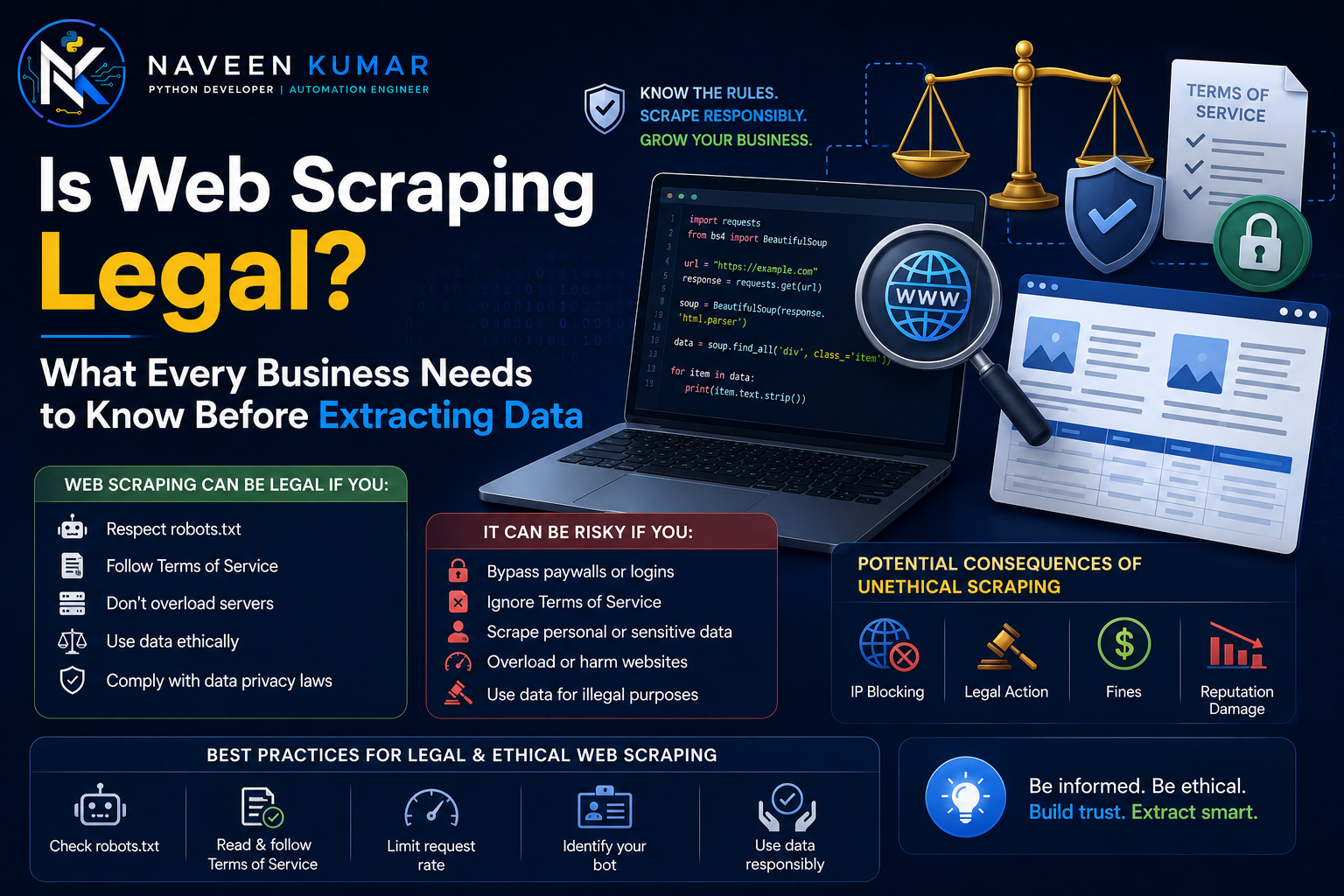
Think of scraping legality as three zones. Green: public, non-personal business data at reasonable volumes. Yellow: terms-of-service conflicts and aggressive volumes. Red: personal data at scale, logged-in areas, and republishing copyrighted content.
| Zone | What It Covers | Practical Risk |
|---|---|---|
| 🟢 Green | Public prices, product details, property listings, government/open data, your own accounts’ data, news headlines for internal analysis | Low — standard market-research practice |
| 🟡 Yellow | Sites whose terms prohibit scraping; high-volume scraping; business contact lists; competitor sites specifically | Blocking is likely; legal letters possible in direct-competitor disputes |
| 🔴 Red | Personal data of individuals at scale, anything behind a login, bypassing paywalls/CAPTCHAs aggressively, republishing scraped articles/images as your content | Real legal exposure — IT Act, DPDP Act, copyright |
Most business scraping projects — the price monitors and listing trackers we build week in, week out — live entirely in the green zone. The rest of this article explains why the lines sit where they do.
What Indian Law Actually Says in 2026
No single Indian statute addresses web scraping directly. Three bodies of law shape it instead: the IT Act 2000 (unauthorised access), the DPDP Act 2023 with its new 2025 Rules (personal data), and ordinary contract and copyright law.
The IT Act 2000: the “unauthorised access” question
Section 43 of the IT Act penalises accessing a computer system without authorisation. The unresolved question is whether visiting a publicly open webpage with a script counts as “unauthorised” — the page is, after all, served to anyone who asks. Indian courts haven’t drawn a clean line yet. Where Section 43 arguments get real teeth is when a scraper breaks through technical barriers: bypassing logins, defeating access controls, or hammering a site hard enough to degrade it. Stay on public pages at polite volumes and this section is rarely the problem.
The DPDP Act: the personal data rulebook (with a genuine contradiction)
India’s Digital Personal Data Protection Act 2023 got its implementing Rules notified in November 2025, with full enforcement phasing in through May 2027 — after which penalties can reach ₹250 crore for major violations. If your scraper collects names, phone numbers, or emails of individuals, this is your law.
Here’s the honest, messy part. The Act contains an exemption (Section 3(c)(ii)) for personal data that a person has made publicly available themselves — which sounds like public social profiles might be fair game. But the government’s stated position in Parliament has been that scraping publicly available personal data still requires consent and compliance. The statute and the official interpretation point in different directions, and no court has settled it. Until one does, the sane business posture is: treat bulk personal-data scraping as high-risk, and don’t build a business model on the exemption.
One clear takeaway: product prices, stock levels, property listings, and business information are not personal data. The DPDP Act doesn’t touch the typical price-monitoring project at all.
Contract law: the terms-of-service angle
Many websites prohibit automated access in their terms of use. Violating terms is a civil contract matter — nobody goes to jail for it — but it gives the site owner grounds to block you and, in commercial disputes between competitors, grounds for a legal claim. In practice, the businesses that receive lawyer letters are almost always scraping a direct competitor at heavy volume, not doing broad market research.
Copyright: what you do with the data matters
Facts aren’t copyrightable — a price is a price. But creative content is: articles, photos, descriptions written by the site. Scraping a competitor’s product photos and descriptions and publishing them on your own store isn’t a scraping problem, it’s straight copyright infringement. The rule of thumb: extract facts for analysis freely; never republish someone else’s creative work as yours.
What About Those Famous Foreign Cases?
The best-known scraping lawsuits are American, and their headline lesson holds up: courts have repeatedly declined to treat scraping public data as “hacking.” But foreign rulings don’t bind Indian courts, so use them as context, not cover.
The case everyone cites is hiQ vs LinkedIn in the US, where courts held that scraping publicly visible profiles didn’t violate anti-hacking law — while the dispute still ended in a settlement built on LinkedIn’s terms of service. That two-part outcome is the whole story in miniature: public data scraping keeps surviving the “is it hacking?” test, and terms-of-service claims keep having teeth anyway. Assume both things are true for your project and you’ll rarely be surprised.
A Practical Pre-Scraping Checklist for Businesses
Before commissioning any scraping project, run it through six questions. Ten minutes here prevents the two expensive outcomes: a blocked scraper you already paid for, or a legal letter with your company’s name on it.
- Is the data public? If you need a login to see it, stop and look for an official API or data licence instead. This single rule removes most of the real legal risk.
- Is any of it personal data? Names, phones, emails of individuals = DPDP territory = get legal advice first. Business listings and prices = proceed.
- Does the site sell the data officially? Many platforms offer APIs or feeds. Sometimes ₹5,000/month for an official feed beats a ₹40,000 scraper that fights anti-bot systems forever.
- What volume do you actually need? A polite scraper that checks 500 pages once a day is a different animal from one hammering a site every minute. Volume drives both blocking risk and the “damage to the site” legal argument.
- What will you do with the output? Internal analysis and pricing decisions: fine. Republishing the scraped content publicly: copyright problem.
- Would you be comfortable explaining the project to the site’s owner? Not a legal test — a smell test. If the answer is no, the project probably belongs in the red zone.
A competent developer should walk you through these questions unprompted. In our experience, the projects that go wrong were sold by developers who said yes to everything — the “is that part legal?” conversation is a feature of a good vendor, not friction.
Web Scraping Compliance for Hyderabad Businesses
For Hyderabad companies, the scraping-legality question increasingly cuts both ways: the city’s businesses commission a lot of scraping, and its IT and pharma firms are also among those preparing for DPDP compliance ahead of the May 2027 enforcement date.
Local texture worth knowing: Hyderabad was one of the cities where MeitY held public consultations on the DPDP Rules before finalising them — the compliance wave is not a distant Delhi matter here. The city’s pharma companies around Genome Valley and health-tech firms in HITEC City handle sensitive data, which puts them under the strictest reading of the new rules; if that’s you, your scraping projects deserve the same compliance review as the rest of your data operations.
For the typical commissioning business — the Kukatpally marketplace seller monitoring prices, the Kondapur real estate team tracking listings, the Begumpet distributor watching supplier catalogs — the picture is simpler: that work is green-zone, non-personal, public data, and it’s the bread and butter of legitimate data extraction across Hyderabad, Mumbai, Bangalore, New Delhi, Chennai, Noida, and Pune alike.
Naveen Kumar Software Solutions builds scraping and data extraction tools from Hyderabad with a stated policy: we don’t take projects involving bulk personal-data collection or logged-in scraping, and we’ll tell you in the first call if your target is better served by an official API. It costs us some projects; it saves our clients from the expensive kind of surprise.
Frequently Asked Questions
Is web scraping illegal in India?
No — there is no Indian law that bans web scraping itself. Scraping publicly visible, non-personal business data (prices, listings, product details) is common commercial practice. Legal risk appears when scraping collects personal data, breaks through logins or technical barriers, copies copyrighted content wholesale, or violates a site’s terms of service at scale.
Does the DPDP Act ban scraping personal data?
It’s genuinely unsettled. The DPDP Act’s Section 3(c)(ii) appears to exempt personal data made publicly available by the person themselves, but the government’s stated position is that scraping public personal data still needs consent and compliance. With full enforcement arriving May 2027 and penalties up to ₹250 crore, the safe business move is to treat personal-data scraping as high-risk and get legal advice first.
Can I scrape a website that says “no scraping” in its terms?
You can be blocked for it, and in commercial disputes it can become a breach-of-contract claim — a civil matter, not a criminal one. Most price-monitoring of public pages carries low practical risk, but scraping a direct competitor at heavy volume against their written terms is where businesses actually get legal letters. Judge it case by case.
Is it legal to scrape data behind a login?
This is the highest-risk category and generally best avoided. Logged-in areas come with accepted terms, and bypassing access controls can attract IT Act Section 43 (unauthorised access) arguments plus account bans. If the data you need sits behind a login, ask whether the site offers an official API or data licence instead.
Can I legally scrape Google Maps or JustDial business listings?
Business names, addresses, and ratings are business information, not personal data, which lowers the privacy risk — but both platforms prohibit scraping in their terms and actively block it. Many businesses do it for lead research anyway; the practical exposure is mostly blocking, not lawsuits. Owner mobile numbers edge toward personal data, so handle those carefully.
Want a Straight Answer on Your Specific Project?
Send us the site and the data you’re after. We’ll tell you which zone it falls in, whether an official API exists, and what a compliant build would cost — within one working day. If it needs a lawyer instead of a developer, we’ll say that too.